Analyzing Evolutionary Trade-Offs in Immune Systems: Computational Biology with Reese Martin
By Nick McCoy, Evolutionary Studies undergraduate communications assistant聽
Reese Martin has always been drawn to biology and exploring the behaviors of different organisms. During his childhood, he dug in anthills, and now he observes the life history traits of flower beetles and other taxa. Martin鈥檚 new first-author paper, 鈥�,鈥� was published in the Proceeding of The Royal Society B in June 2024. Working under the guidance of assistant professor of Biological Sciences , Martin explored the role of genetic pleiotropy in evolutionary biology and its impact on trade-offs among life-history traits in host and parasite populations.聽
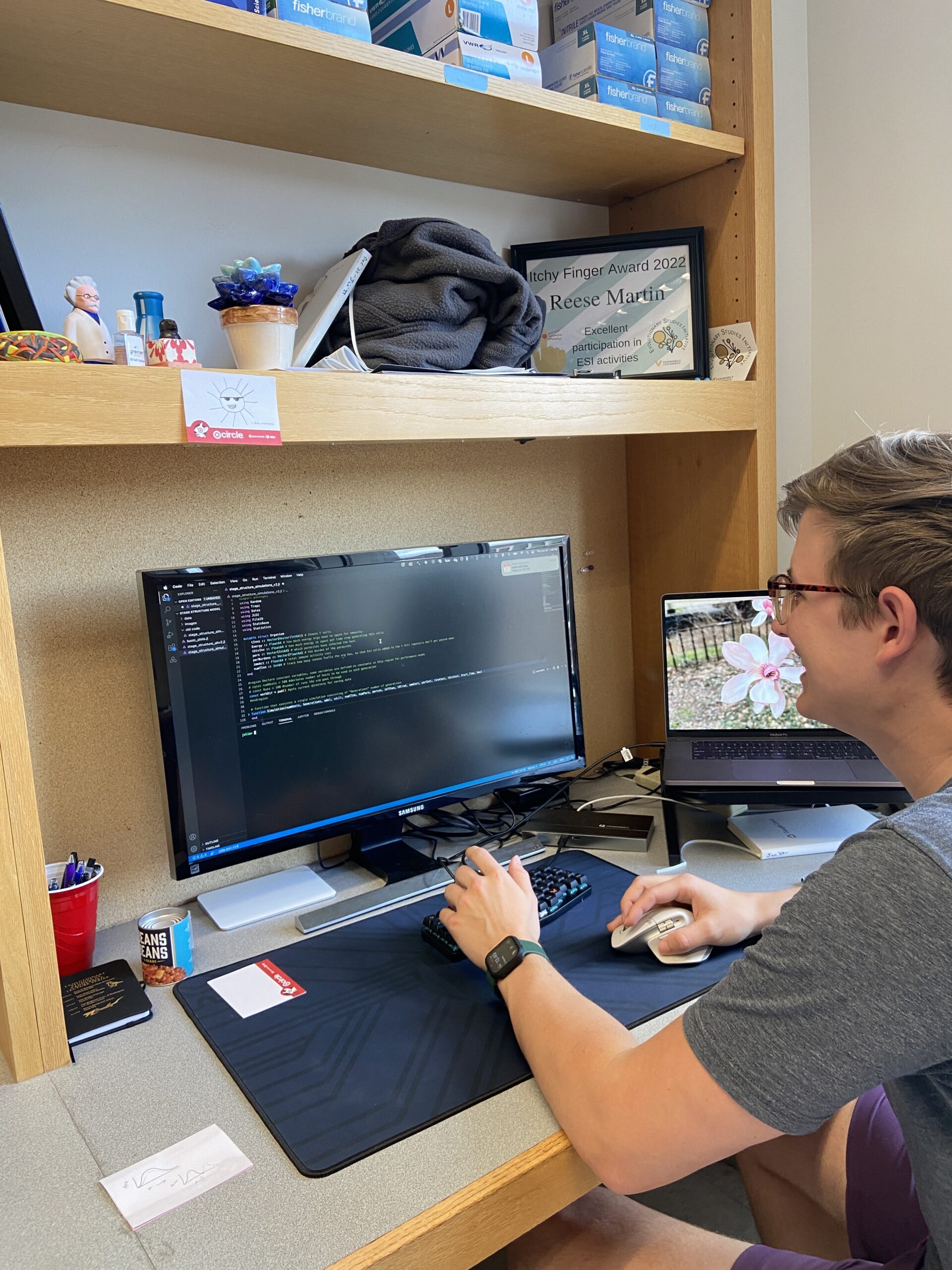
According to Tate, 鈥済enetic pleiotropy is when genes have multiple functions.鈥�
Pleiotropic genes also evolve slowly and are common in the immune system of humans, insects, and plants, and as Martin鈥檚 findings note, 鈥減lay double duty in defending against parasites and driving other important traits like development.鈥� Martin鈥檚 published research focuses on understanding why these slowly evolving genes are so prevalent in a system that otherwise evolves quickly.聽
Martin was drawn to the Tate Lab because of its use of a diverse range of methodologies to address questions related to the evolution of the immune system. Martin鈥檚 Ph.D. work focuses on the computational side of the lab鈥檚 research, which utilizes an agent-based model 鈥� a simulation that studies the interactions between variables such as people, environments, or stimuli 鈥� to code for and simulate coevolution between parasites and hosts. Dr. Tate highlighted that another advantage of an agent-based model is its ability to adapt to various variations and provide optimal flexibility.
Key Objectives
At the onset of this project, Martin鈥檚 framework originated from the understanding that immune signaling networks evolve rapidly, driven by the need to keep up with evolving parasites. Martin explained that this dynamic is often referred to as an ‘arms race’ between the immune networks and the parasites.聽
The Toll and proPO signaling pathways in insect immune systems inspired Martin鈥檚 model due to their crucial roles in both development and immunity, leading him to explore the evolutionary conditions favoring such configurations. The Toll pathway is involved in embryo development as well as the immune response to fungal and bacterial infections, while the proPO pathway is a critical part of melanization, which is necessary for defense against foreign materials and for the cuticle tanning process.聽
According to their paper, Martin and Tate establish that these 鈥渉osts are defined by a pair of signaling networks, one developmental and the other immune,鈥� prompting Martin to further investigate the role of pleiotropic genes and their influence on development, physiology, and disease.
Martin鈥檚 model reflected a variety of organisms such as the common fruit fly, domestic sheep, thale cress, mice, spongy moths, and flower beetles. These organisms underwent co-evolutionary and competitive simulations to generalize pleiotropic pathways across different species, mirroring the real influences these systems have on adaptation, resource allocation, and fitness trade-offs.
Putting Theory into Practice: Analyzing the Genetic Relationships
Martin鈥檚 research and simulated agent-based model explored how pleiotropic and independent signaling networks influence the fitness of parasitic manipulation. His computational findings revealed that, although non-pleiotropic hosts in the selected immune systems can achieve higher peaks in adaptation, they are eventually outcompeted by pleiotropic ones. This is because pleiotropic genes in the immune system, despite evolving more slowly, offer better protection against parasites and enhance robustness in rapidly evolving immune systems.聽
Based on Martin鈥檚 most recent paper, he discovered that 鈥減leiotropy does not actually constrain the evolution of immune systems as much as we think; the network can evolve around this constraint.鈥�
Resource Allocation and Pathways for Future Research聽
One of the biggest takeaways from Martin鈥檚 research was the insight into resource allocation and how pleiotropic individuals can outcompete non-pleiotropic ones in certain evolutionary scenarios.聽聽
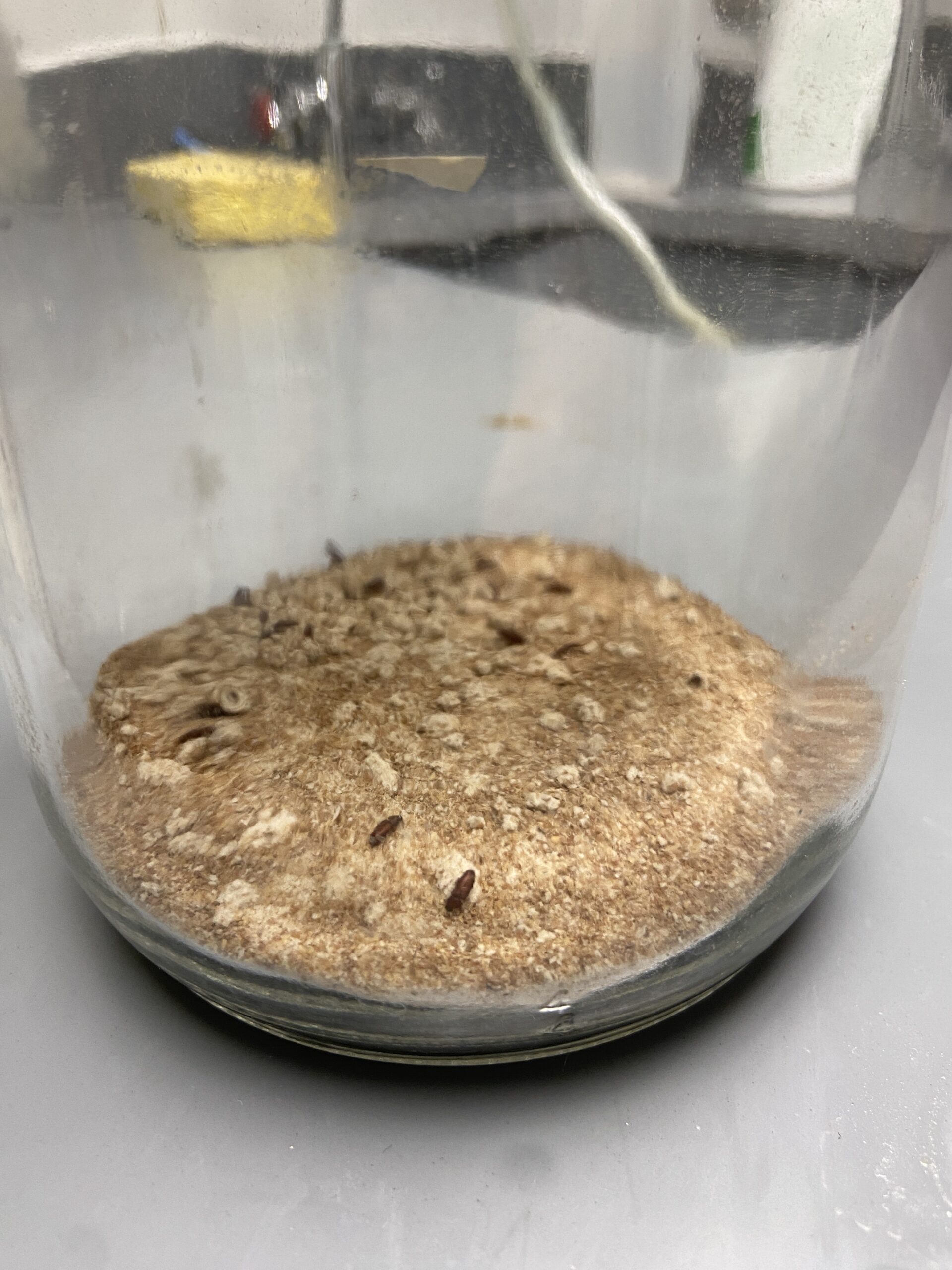
鈥淚f you do not have enough energy to do two jobs separately, it can be beneficial to share the load with that one protein,鈥� Martin explained. Martin also shared his thoughts on how these findings could inform his future research, explaining that 鈥渆valuating the trade-offs between beetle development and beetle immunity could be mitigated or managed with resource allocation and how it is related to pleiotropic proteins that do both development and immunity.鈥澛�
Understanding how resource allocation problems arise and how they are managed on the organismal side of things is a key component of Martin鈥檚 broader research goals.
When discussing the findings of Martin鈥檚 work, Tate shared that 鈥渉aving evolution structured around pleiotropy can enhance immune system robustness and provide a competitive advantage when comparing different genotypes.鈥澛�
Why Computational Biology Matters
Computational biology is a crucial component of the work happening in the Tate Lab. The research requires a different approach, one that allows for the investigation of otherwise inaccessible biological problems. Martin emphasized the efficiency of computational methods in his agent-based model, highlighting that scientists can make progress on problems that are intractable with current methods/technology and can help narrow the focus of wet lab projects.聽
鈥淐omputational modeling can be a really big help and is useful in understanding what is going on by complementing experimental approaches with modeling approaches,鈥� Tate noted, 鈥渆specially in uncovering complex processes like immune responses within hosts.鈥�
Computational biology comes with an added benefit, according to Martin, stating, 鈥淚f you are an impatient scientist, then you should be a computational scientist.鈥�
His remark underscores the speed at which computational projects can progress and encourages upcoming students to engage with computational work.
Citation: Martin, Reese A., and Ann T. Tate. “Pleiotropy alleviates the fitness costs associated with resource allocation trade-offs in immune signaling networks.” Proceedings of the Royal Society B 291, no. 2024 (2024): 20240446.
Funding information: This work was supported by the National Institute of General Medical Sciences at the National Institutes of Health (grant number R35GM138007 to Tate).