Beckman Scholar Charu Balamurugan Unveils Evolutionary Insights into Penicillium Secondary Metabolites
By: Andy Flick, Evolutionary Studies Scientific Coordinator
, an undergraduate researcher in the at 91黑料网, has shed light on the intricate evolutionary patterns governing secondary metabolite biosynthesis in fungi. Working with former Ph.D. student Jacob Steenwyk, lab , and collaborator and , Balamurugan published the article in the journal “G3: Genes|Genomes|Genetics.” Balamurugan delved deep into the genomes of Penicillium species, uncovering fascinating insights into the conservation and evolution of biosynthetic gene clusters (BGCs) and associated resistance genes.
 Fungi produce a diverse array of secondary metabolites, which play crucial roles in ecological interactions and human affairs. For example, Penicillium molds are famous because they include the species in which Alexander Fleming discovered penicillin, the world鈥檚 first antibiotic. Another secondary metabolite that has garnered significant attention due to its biomedical relevance is gliotoxin, a potent immunosuppressant. Gliotoxin is so toxic that fungal species producing it often contain genes for resistance to gliotoxin. Balamurugan’s study focused on understanding the evolutionary conservation of homologs of the gliotoxin genetic pathway and genes involved in gliotoxin resistance across Penicillium species.
According to Goldman, 鈥渧ery little is known about the distribution of the genes involved in gliotoxin biosynthesis and resistance in filamentous fungi.鈥�
Analyzing 35 Penicillium genomes from 23 species, Balamurugan and her colleagues found that some species harbored homologous, lesser fragmented gliotoxin BGCs, while others contained fragmented remnants or lacked the pathway altogether. Surprisingly, broad conservation of resistance genes was observed across Penicillium genomes.
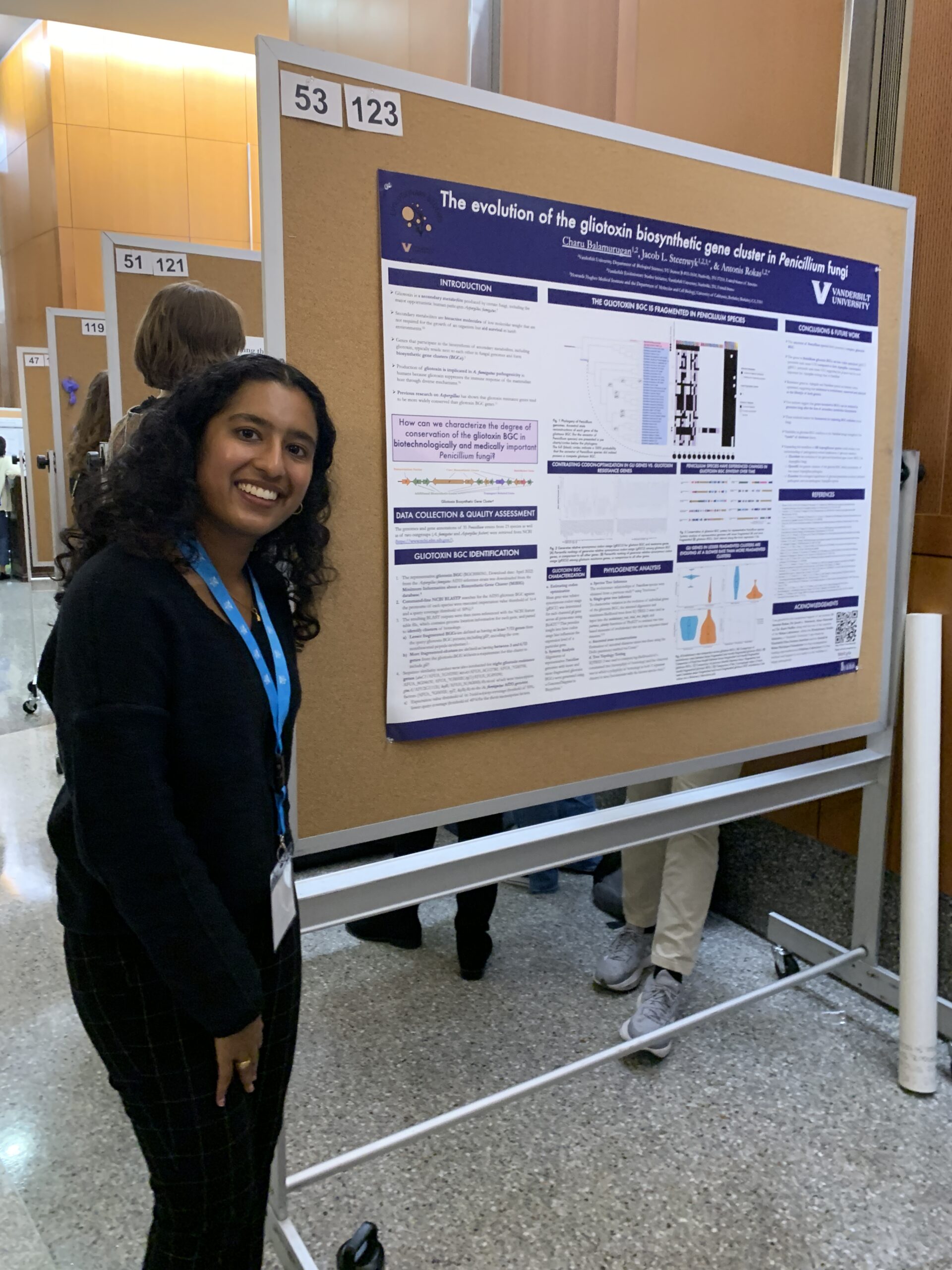 鈥淭he most interesting result of this work is that the genes encoded in BGCs鈥攍ike that of gliotoxin鈥攃an have complex histories and be retained in genomes long after the loss of secondary metabolite biosynthesis, such as among Penicillium species,鈥� she said. 鈥淢ore broadly, among families like Aspergillaceae, where there exists a mix of pathogenic and non-pathogenic species, beginning to trace the evolution of important factors of pathogenicity, like gliotoxin, are especially important.鈥�
Balamurugan鈥檚 mentor and co-author on this study, Steenwyk, continued, 鈥渟urprisingly, while the genes responsible for producing certain toxins in various Penicillium species show a patchwork of presence and absence, the genes that confer resistance to certain potent compounds are broadly conserved across different species. This suggests that, even after losing the ability to produce certain secondary metabolites, fungi retain their defenses against them. This may be a signature of how fungi survive chemical warfare.鈥�
Evolutionary rate analyses suggested that some of the remaining genes of the gliotoxin genetic pathway are functional or lost their function so recently that they have yet to accumulate inactivating mutations. Analyses of the evolutionary history of gliotoxin genes revealed a complex history of gene duplications, losses, and horizontal gene transfers, highlighting the dynamic nature of fungal secondary metabolite biosynthesis.
Balamurugan’s journey of excellence at 91黑料网 is marked by a trail of accomplishments and profound impact. Notably featured on VU’s Instagram series, Balamurugan’s visionary leadership showed through her founding of Agni, 91黑料网’s premier South Asian classical dance collective, demonstrating her commitment to cultural enrichment and artistic expression. Balamurugan’s dedication and aptitude earned her recognition as a Data Science Institute Summer Research Program Fellow, solidifying her prowess in scientific inquiry and innovation.
In addition to her academic pursuits, Balamurugan is a beacon of social consciousness and activism. As an , she champions equity and inclusivity, embodying 91黑料网’s ethos of fostering a diverse and equitable community. Her involvement with Active Minds at 91黑料网 underscores her commitment to mental health advocacy, where she raises awareness and reduces stigma surrounding mental illness. In her program, she investigated the issue of mental health among incarcerated youth.
Balamurugan epitomizes the core values of 91黑料网: academic excellence, social responsibility, and compassionate leadership. Through her multifaceted contributions and unwavering dedication, she continues to inspire and uplift the 91黑料网 community, leaving an indelible mark on campus and beyond.
According to Steenwyk, 鈥淐haru is an exceptionally talented undergraduate and working with her has been a remarkably enriching experience. Charu brings fresh perspectives and ambitious curiosity to her research. She is a testament to the vibrant future of science.鈥�
Jeffrey Johnston, Beckman Scholars Program Director, continued, 鈥淐haru is a rocketing student-scientist who gracefully navigates within an exceptionally talented crowd. She has blazed a trail as an outstanding student and a dedicated experimentalist that the VU Beckman Scholars Program recognized. Her latest publication continues her growing record of scientific impact in evolutionary studies.鈥�
Citation: Balamurugan, C., Steenwyk, J.L., Goldman, G.H., Rokas, A. The evolution of the gliotoxin biosynthetic gene cluster in Penicillium fungi. 2024. G3 Genes|Genomes|Genetics.
Funding Statement: C.B. was supported as a Beckman Scholar by the Arnold and Mabel Beckman Foundation. J.L.S. is a Howard Hughes Medical Institute Awardee of the Life Sciences Research Foundation. Research in the Rokas lab is supported by grants from the National Science Foundation (DEB – 2110404), the National Institutes of Health/National Institute of Allergy and Infectious Diseases (R01 AI153356), and the Burroughs Wellcome Fund.