Lasko, Thomas A.; Stead, William W.; Still, John M.; Li, Thomas Z.; Kammer, Michael; Barbero-Mota, Marco; Strobl, Eric V.; Landman, Bennett A.; Maldonado, Fabien. “â€�ÌýJournal of Biomedical InformaticsÌý166 (2025): 104837.Ìý.Ìý
Ìý
This study uses a method based onÌýprobabilistic independenceÌýto help uncover the hidden, patient-specific causes—or “sources”—of disease using data from electronic health records (EHRs). In this approach, each disease source is treated as anÌýunobserved root causeÌýin a network that influences various observed medical variables like lab tests, medications, billing codes, and demographics. The effects of each source—itsÌýsignature—are the patterns these causes leave behind in the data.Ìý
By analyzing a large dataset of over 269,000 patient records and 9,195 variables, the model was able to infer 2,000 potential disease sources and their unique signatures. To test the method, the researchers used it to explore the causes ofÌýbenign vs. malignant pulmonary nodulesÌý(small spots in the lungs) in more than 13,000 cases. The model successfully identified 92% of known malignant causes and 30% of benign ones listed in an external reference. It also uncovered several likely causes not included in the reference list, but supported by other medical literature.Ìý
In many cases, the model couldÌýdecomposeÌýa general diagnosis into more specific patterns related to disease progression or treatment. For example, a common malignant cause could be broken down into five or more detailed sub-patterns. Interestingly, the model also flagged many patients who may have hadÌýundiagnosed cancer, based on their data patterns.Ìý
These findings show that even from noisy, incomplete, and irregular health records, it’s possible to extract meaningful,Ìýpatient-specific causes of disease. This could eventually help clinicians better understand complex cases and make more precise treatment decisions tailored to individual patients.Ìý
 Ìý
Ìý
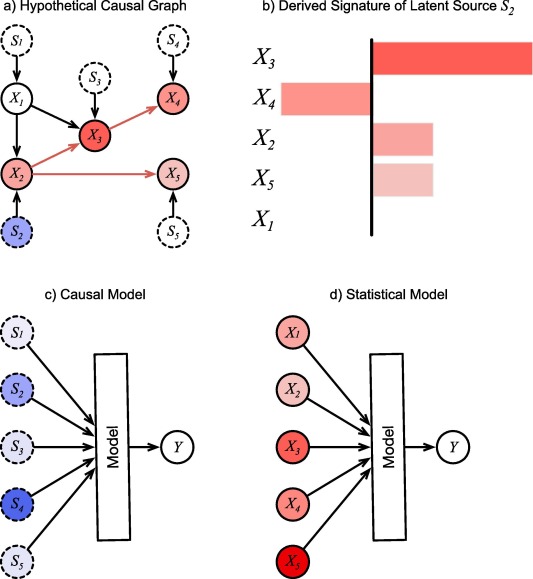
Fig. 1.ÌýA hypothetical causal graph and structured derived from it. a) The causal graph inferred from observing theÌýÌý(solid circles) over many records. TheÌýÌýare inferred latent sources (dotted circles). Colors of the nodesÌýÌýindicate the degree to which a unit change in sourceÌýÌýaffects them. They are arbitrary here for illustration, except forÌý, which cannot be affected byÌý. b) Causal effects of sourceÌýÌýcollected into a bar-graph signature c) Causal model ofÌýÌýusing latent sourcesÌýÌýas inputs. d) Statistical model ofÌýusing observationsÌýÌýas inputs. Color intensity of inputs represent their hypothetical importance values for the prediction in a single instance. For the causal model, the inputs are mutually independent root nodes, and therefore can be interpreted as the causal sources ofÌý, which may suggest treatment approaches that address the specific causes for this patient, and which may be manipulated to investigate different counterfactual scenarios. For the statistical model, the importance values remain entangled and cannot be interpreted this way.Ìý
Ìý